What Are Essential in Making Beef Stock
This is a classical French-style recipe for bootleg beefiness stock. Information technology'southward vastly superior to whatsoever store-bought stock, and is one of the primary things that distinguishes home and restaurant cooking.
It takes fourth dimension to make, but if you truly want the best, it's worth it!
More stocks: chicken stock | vegetable stock
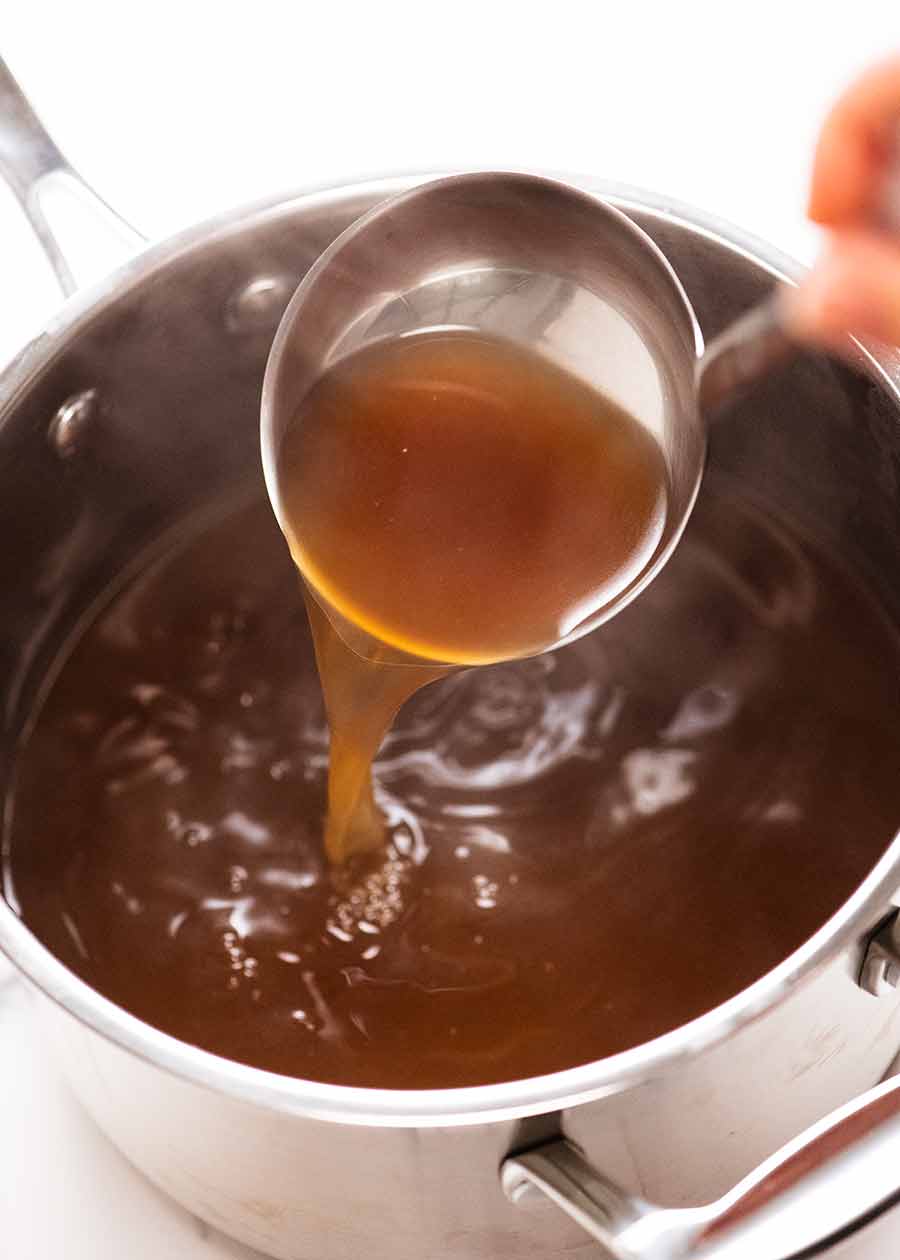
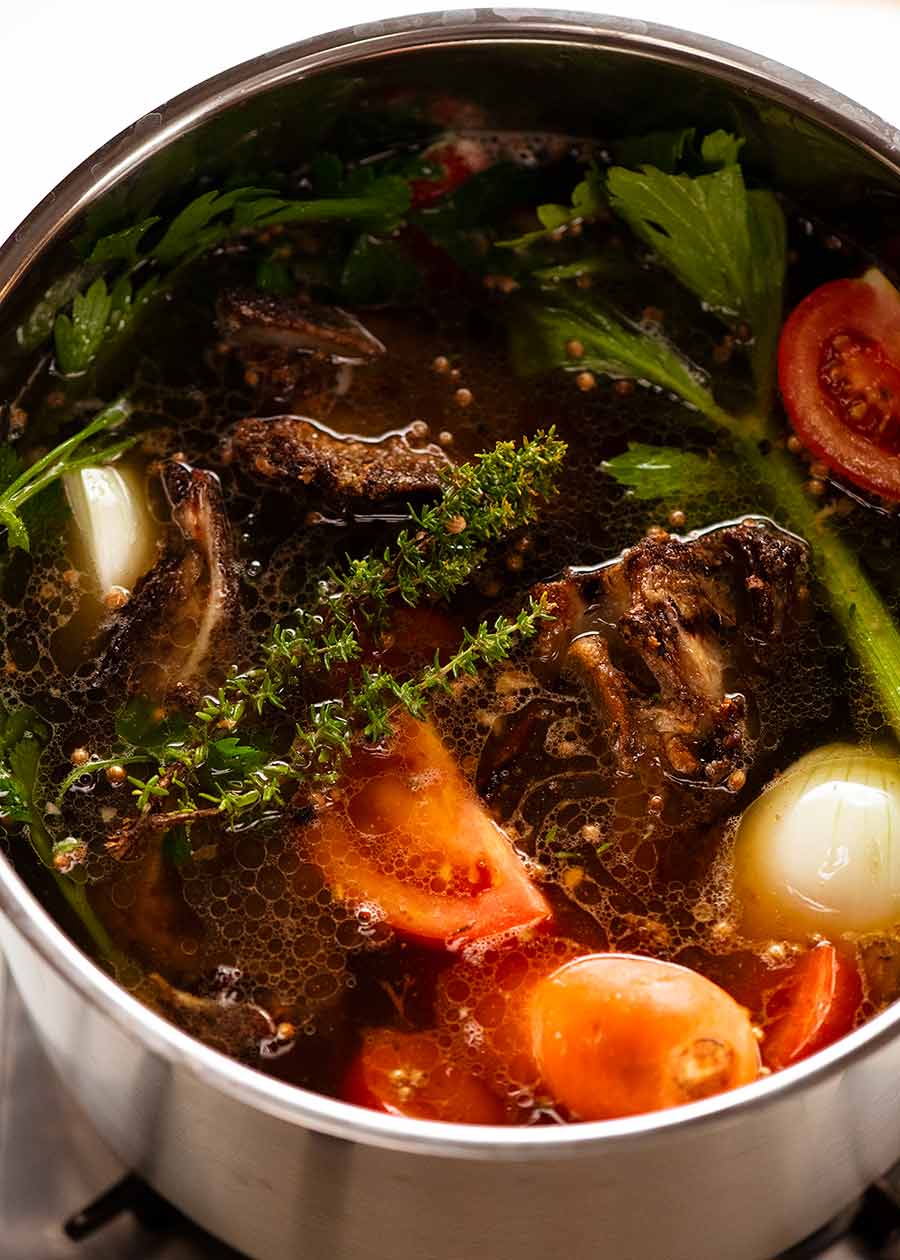
Let me say from the outset: bootleg beef stock requires effort. It takes fourth dimension – I'm talking minimum four hours, up to ten hours is all-time – at that place's a pile of hot bones to discard, and big cooking vessels that'll need cleaning.
So ane might ask:
Why make beef stock at home?
Because it is so vastly superior to whatsoever store-bought stock. While I call up that (about) store bought chicken stock is really pretty adept these days and vegetable stock is passable, beef stock has never been that nifty.
Homemade beef stock has:
-
Far ameliorate flavour – Store bought stock does not compare to real, freshly made stock. A simple gustation is all it takes to confirm this;
-
Richer mouthfeel – Gelatin from the bones and connective tissue in beef bones is what gives a stock its full-bodied richness and mouthfeel when used in soups and stews etc, too as natural thickness when highly reduced for use as a jus or in sauces. Store-bought stock lacks this quality;
-
More versatile because it'due south unsalted – Store-bought stock is almost always salted. This is fine when used at normal concentrations, but if stock is reduced a lot when making ragus, sauces and so on, the table salt can become excessive – yet at that place is little you can do about it. Homemade stock on the other paw is unsalted, and then yous will never have this problem and tin command seasoning in the finished dish; and
-
Cheaper than high quality shop-bought stocks. Aye, regular supermarket packet beefiness stock (eg. Campbell'south) is cheaper than homemade stock. But it besides tastes quite bogus, because producers are yet to successfully mass-produce cheap beef stock to a decent level of quality. High-end packaged stocks are better, just are very expensive past comparison.
Homemade stock is 1 of the big things that differentiate home and restaurant cooking. Good restaurants always make their own stocks, and is the secret to why their dishes oft accept that richer, deeper, "restaurant-quality" taste to them.
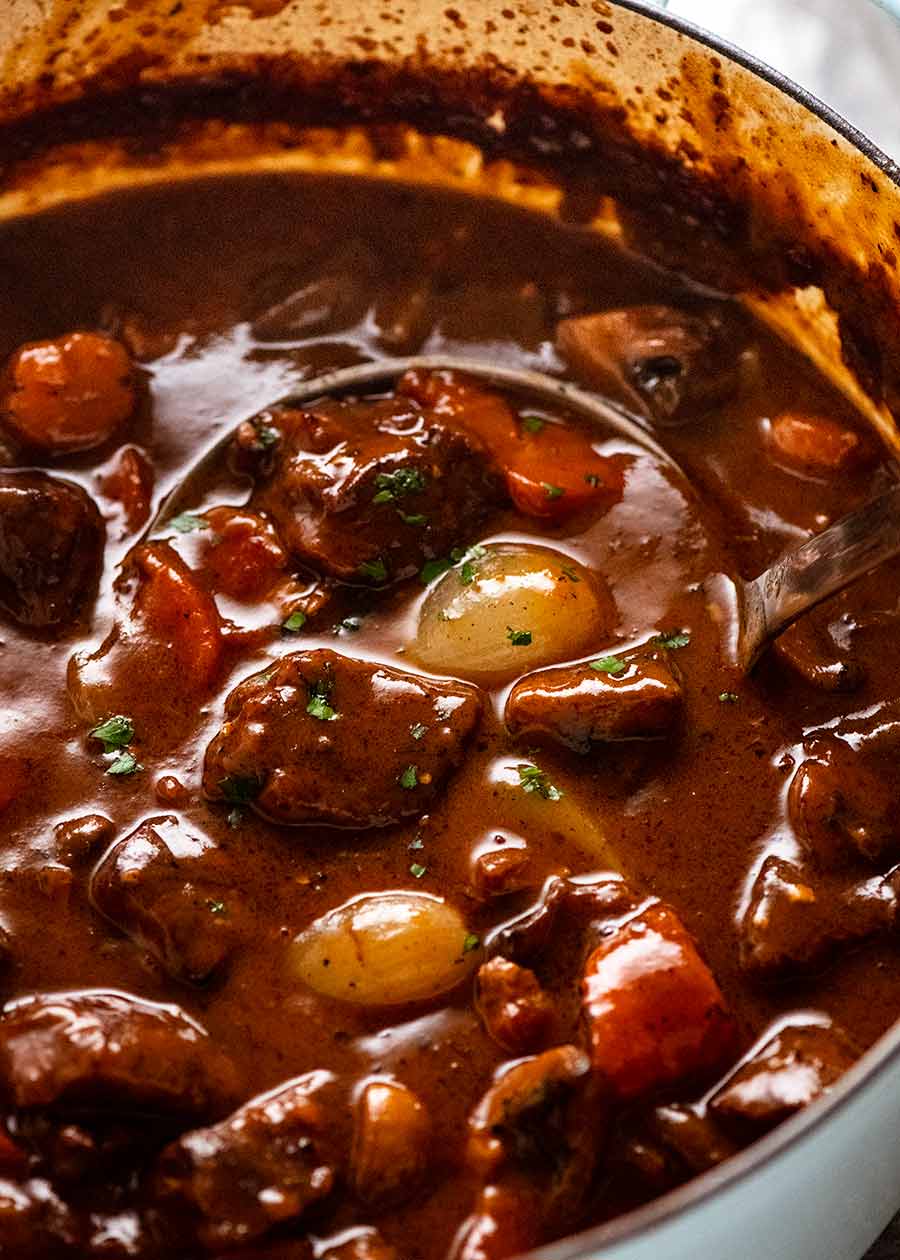
What goes in homemade beef stock
The key ingredient to brand a actually good beef stock is compact bones. No meat, no flavour!
Yous demand 2 1/2 kg / five lb of beefiness bones to make 1 1/4 – one.5 litres / quarts of stock (5 – half-dozen cups).
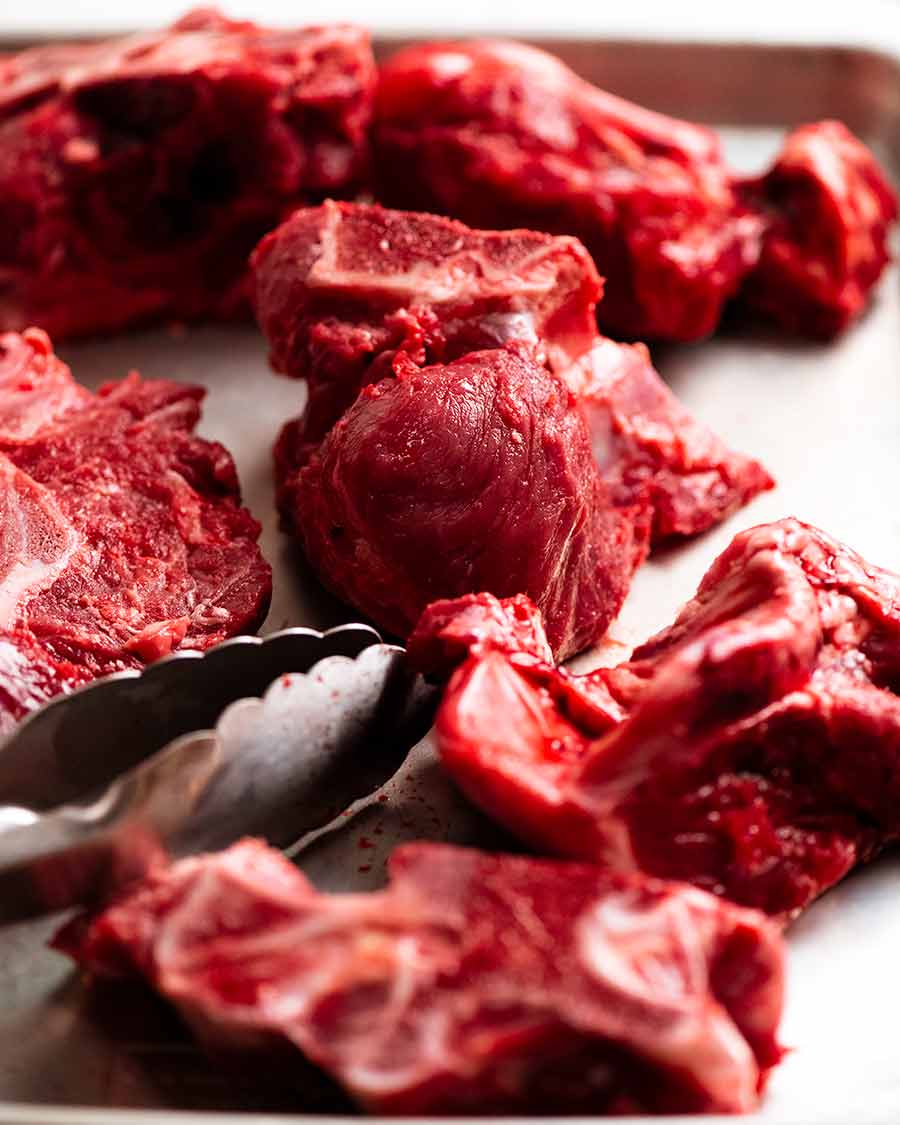
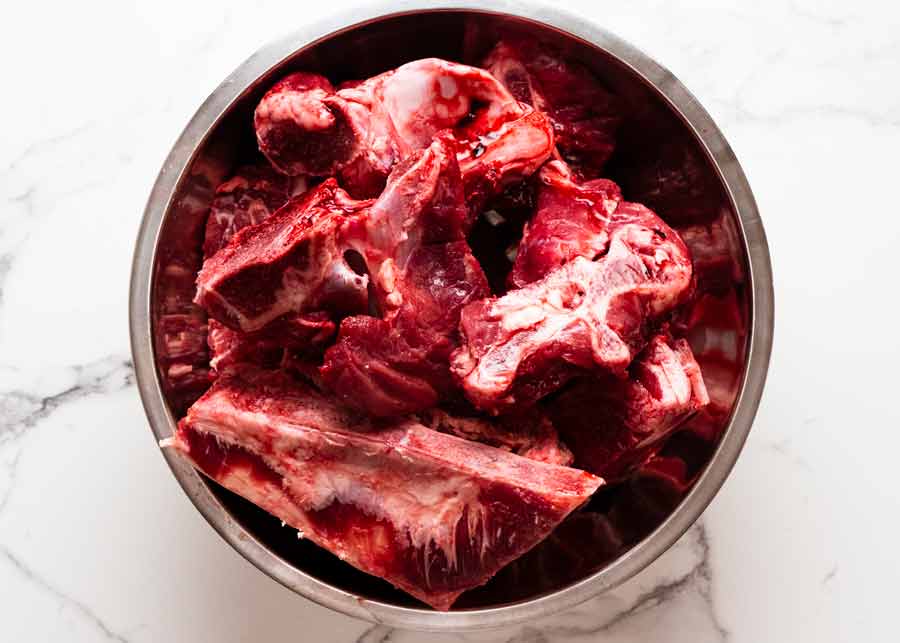
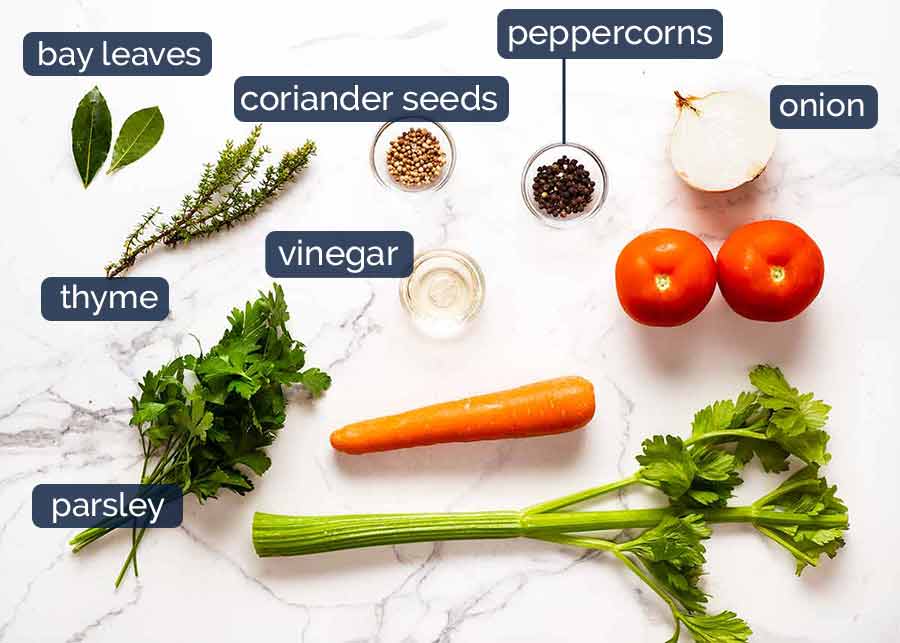
In improver to bones, we as well want aromatics which add together character, deepen the flavour, add a touch of sweetness and also provide some color. Here'south what I utilise:
-
Bay leaves, thyme, parsley, black peppercorns – Herb and spice aromatics, fairly standard;
-
Onion, celery and carrot – Again, familiar building-block ingredients in the stock which add subtle sweetness and flavour;
-
Tomato – Something you don't see in the most basic beefiness stock recipes, this adds a impact of sweet and colour, deepening it to a desirable rich nighttime brown;
-
Cider vinegar – A peachy cheffy touch on, a piffling vinegar helps extract nutrients out of the bone into the broth;
-
Coriander seeds – Another picayune cheffy tip, it adds another layer of subtle complexity to the finished stock. You can't separately identify the flavour, merely a little sense of taste is all it takes to know you've made something special!
Though it takes hours and the manhandling of a (very!) large stock pot, it's really very straightforward to make this beef stock. Also, the dainty thing nearly this beef stock recipe is that there are 3 ways to do the tedious simmer function:
-
On the stove, the traditional way;
-
Oven – Entirely hands off, I've even washed it overnight; or
-
Slow cooker – Assuming you have one large enough.
How to make beef stock
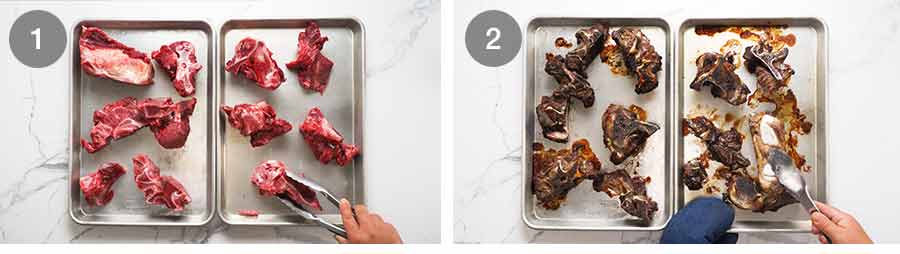
-
Spread bones out on tray to roast. Roasting develops lots of flavour as well equally darkening the colour of the stock;
-
Roast bones for 1 hour at 180°C/350°F, turning halfway, until nicely browned all over;
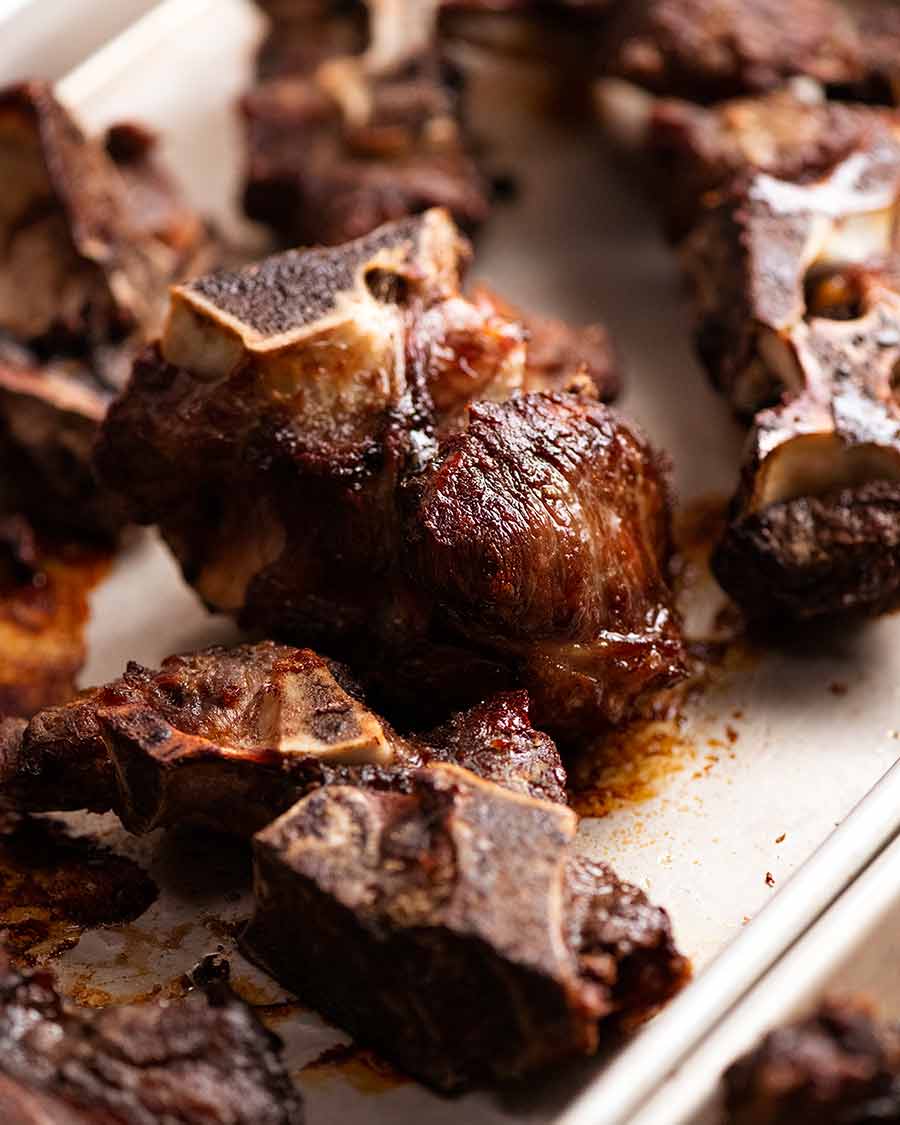
-
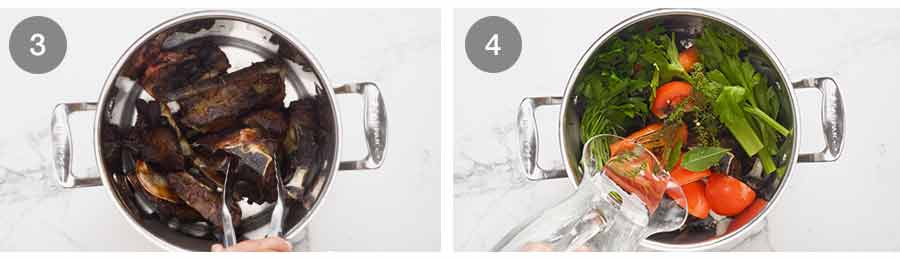
Place beefiness bones in a very large stock pot, at to the lowest degree seven litres / quarts;
-
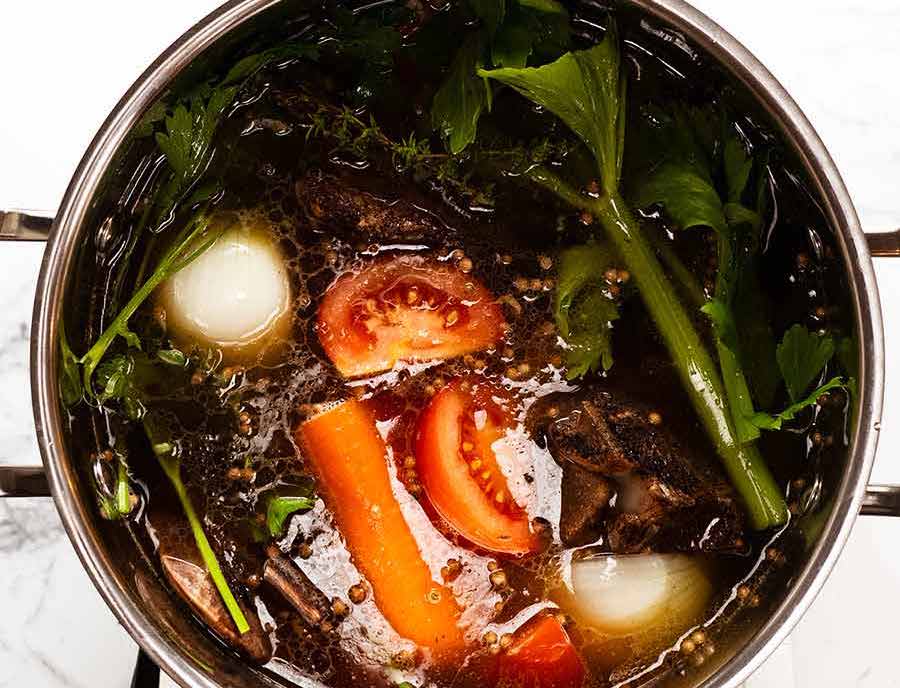
Add the herbs and vegetables, and 3 litres of h2o to just cover the basic. Pack the basic and vegetables downward so you minimise the amount of water required. Nobody wants to end up with a watery beef stock!
-
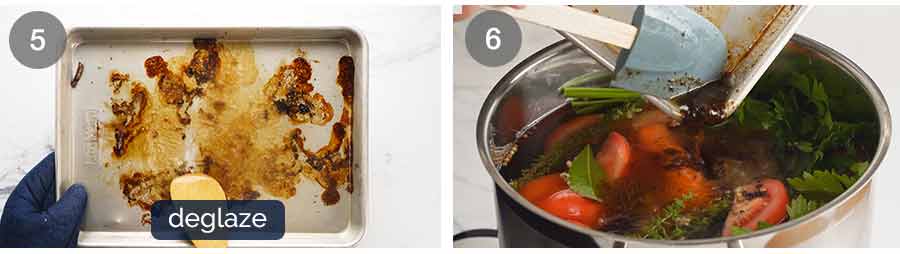
Deglaze the pan – don't waste the precious drippings on the tray, it'due south costless flavour! Pop the tray on the stove, add a splash of water, and as information technology simmers the drippings will dissolve into the water. You could besides do this in the oven;
-
Scrape pan juices into the pot;
-
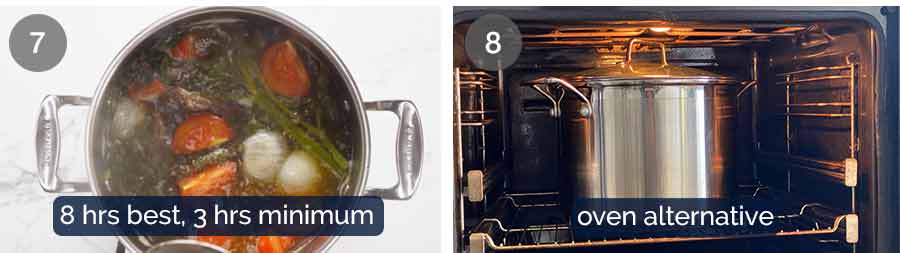
3 – viii hr simmer on stove – Simmer stock on the stove, for a minimum of 3 hours and ideally upwardly to 8 hours. Stove is the traditional method, and it's entirely hands-off. The estrus should exist so low that you only get a little bubble every once in a while, and it doesn't need stirring. Practise non simmer or boil to try to speed things up, it will brand the stock cloudy.
If you exercise the faster, 3 hour simmer … If you lot cull this pick, which we oftentimes deploy because there aren't many times when I can have a pot of stock simmering away all day, nosotros simmer on a marginally stronger estrus level to reduce the h2o faster. In addition, we reduce the stock to concentrate the flavour after straining it.
The season departure betwixt 3 and 8 hours? Well, of course an 8 hour simmer yields a better event. Simply practicality comes into play here, and while the actress five hours does produce an fifty-fifty better result, a three hour simmer volition notwithstanding requite you an exceptional stock;
-
Oven or slow cooker option: Alternatively, you tin cook it in the oven for viii hours or even overnight (my record is 15 hours – it was a magnificent batch!!), OR in the slow cooker for 8 hours on low.
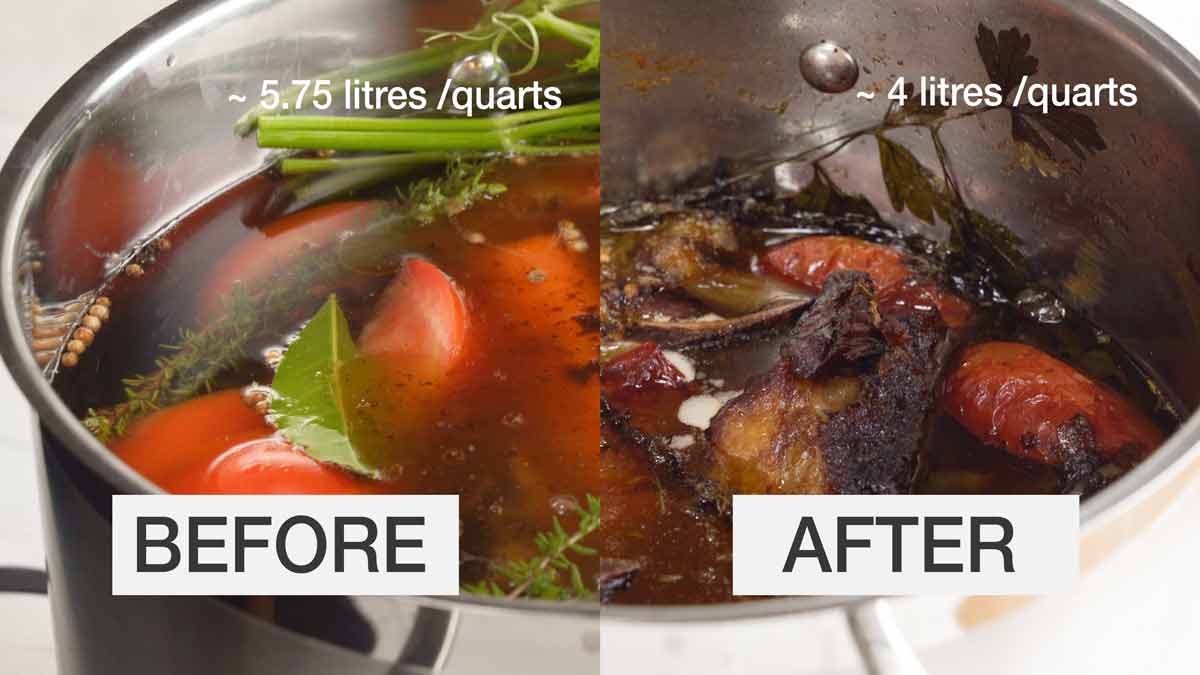
This is what the stock h2o level looks like later on 8 hours on the stove. The h2o level should reduce from effectually the 5.75 litres / quarts mark to around 4 litres (noting this is counting the bones etc nevertheless in the water):
Straining, storage and using
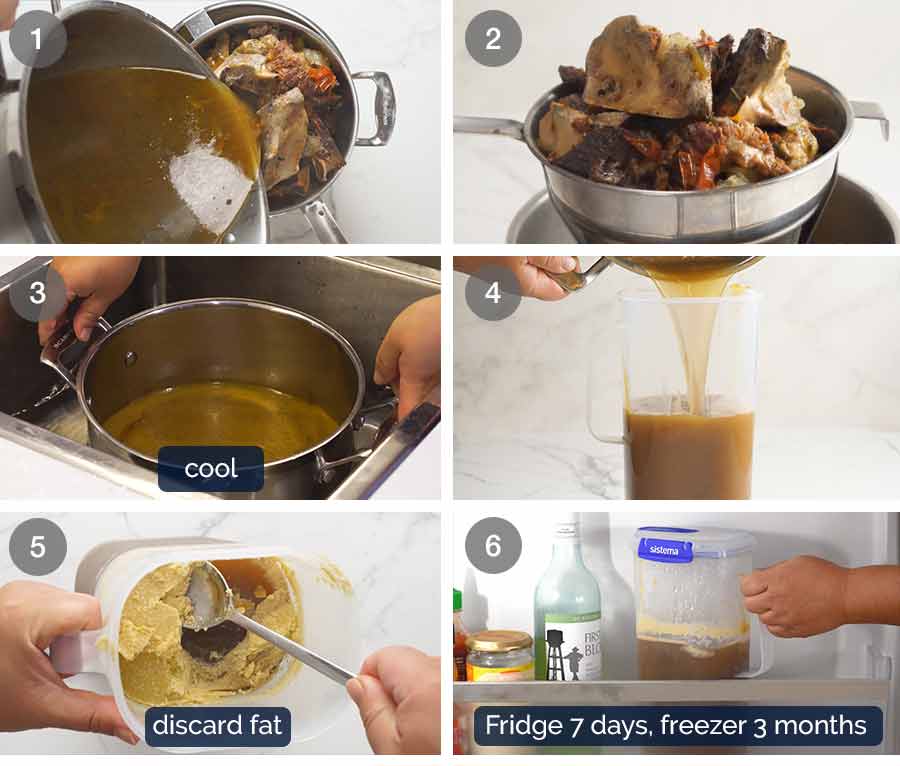
Once the stock has reduced, it's a affair of straining, discarding excess fat then storing for use!
-
Strain – Fish out bones, then strain stock through a fine mesh colander / strainer into a large bowl or clean pot;
-
Yield: ~ 1.3 – 1.6 litres/quarts – Let the vegetable matter sit down there in the strainer for a few minutes to extract every bit much liquid equally possible. You should take effectually 1.5 litres / quarts of liquid. After discarding the excess fat (afterwards step), there should be effectually 1.25 litres / quarts of stock;
-
Cool rapidly by sitting the uncovered pot in a sink full of cold tap h2o. Change the water every 20 minutes or so equally it heats upwards, and information technology should take around i 60 minutes 15 minutes to absurd to room temperature (around 21°C/lxx°F).
It'south important to cool rapidly to prevent leaner from growing (they love cosy warm environments!) so nosotros can become it in the fridge ASAP. Never put a large hot pot of stock in the refrigerator otherwise you will significantly raise the internal temperature of the fridge – that's bad!
-
Refrigerate – Transfer to a suitable storage container – I utilise a jug – then refrigerate;
-
Remove surface fat – Once it has fully chilled in the refrigerator, the fatty floating on the surface volition solidify into a white mass. Use a large, apartment spoon to carefully flake it off and discard.
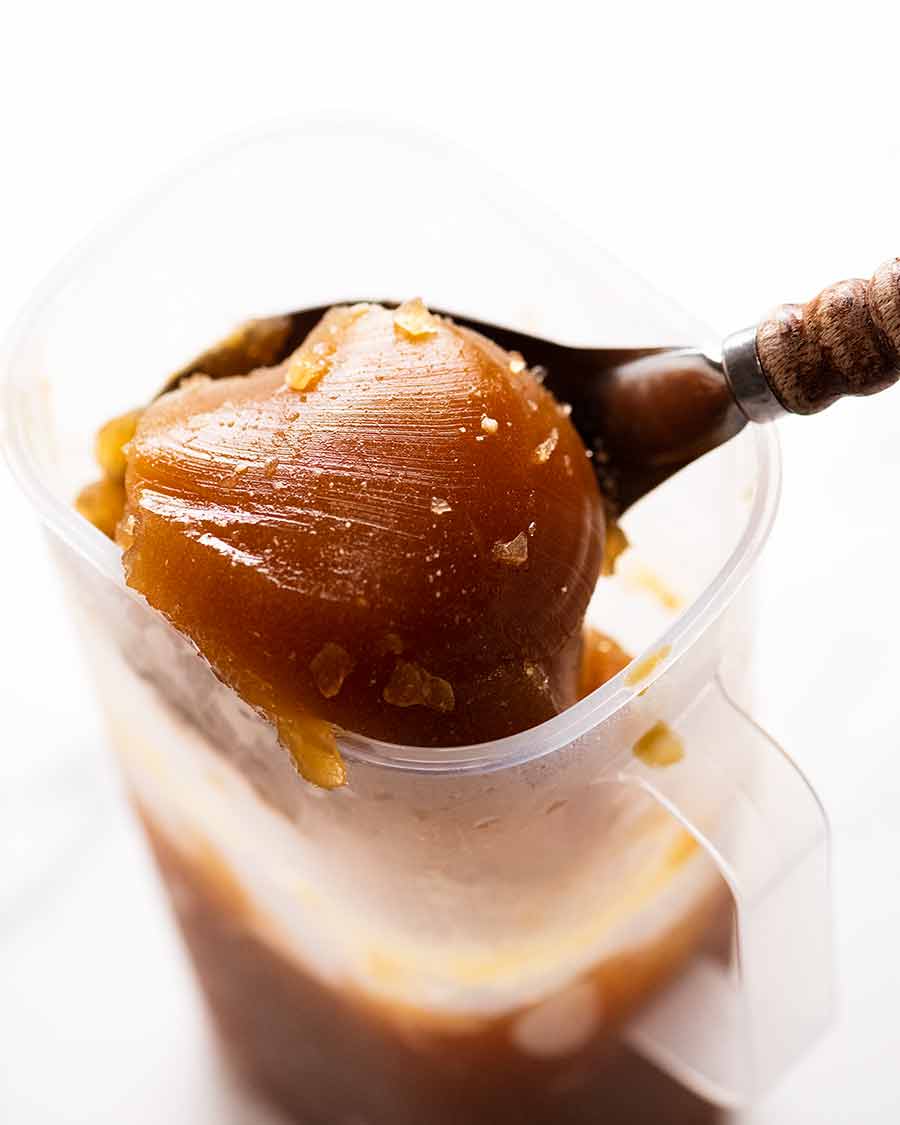
This is what beef stock looks like when chilled and the fat has been removed. Information technology solidifies into a jelly because of the gelatin. Gelatin is what gives the stock that fine-dining eating house, rich mouthfeel. Shop bought stock is always liquid because it has little gelatin.
-
Washed! Your stock is now done and set up for use! It will proceed in the fridge for 7 days (I've been told past a reliable source 10 days is ok, but I say up to vii to err on the side of caution). Else, it tin can freeze for up to three months.
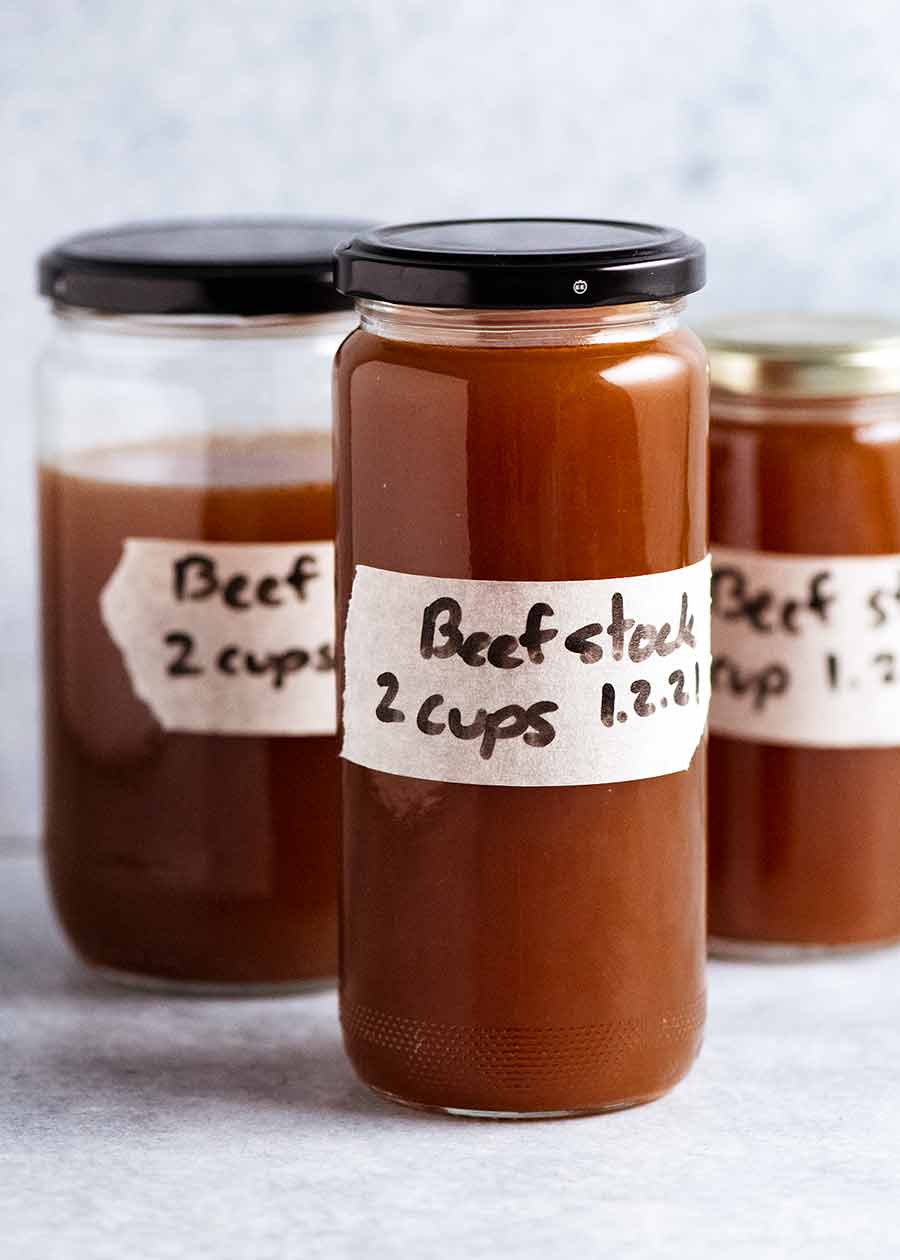
I like to store stock in 1- or 2-cup portions, labelled, in the freezer.
How to use homemade beefiness stock
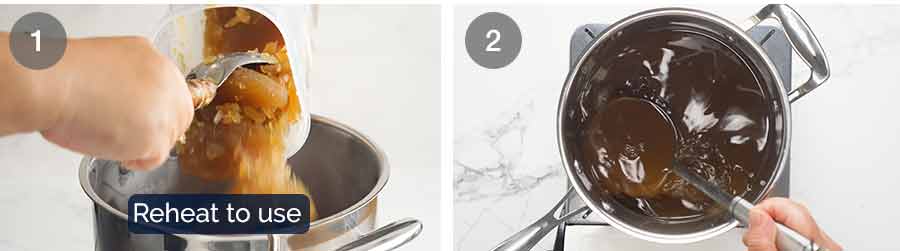
To employ homemade beefiness stock, you can either reheat in the microwave or on the stove to render it to a liquid then information technology can exist measured out. It melts very quickly – literally in a minute or 2.
Information technology can be added straight into dishes in cold jelly form too. For me, it's simply a question of whether I need to mensurate it or non – it'south harder to accurately mensurate out jelly!
What to use homemade beef stock for
Use homemade beef stock for whatever recipe that calls for beef stock or beefiness broth. Your finished dish will exist multiple times better than whatever version made using shop bought, with a far richer, deeper flavour and none of that undesirable artificial edge that store bought beef stock has.
Yous volition gain exceptionally good results when used particularly in tedious-cooked dishes such as stews, also as soups, sauces and gravies (plain or mushroom!).
Here are some suggestions:
Of import: Table salt adjustment when using!
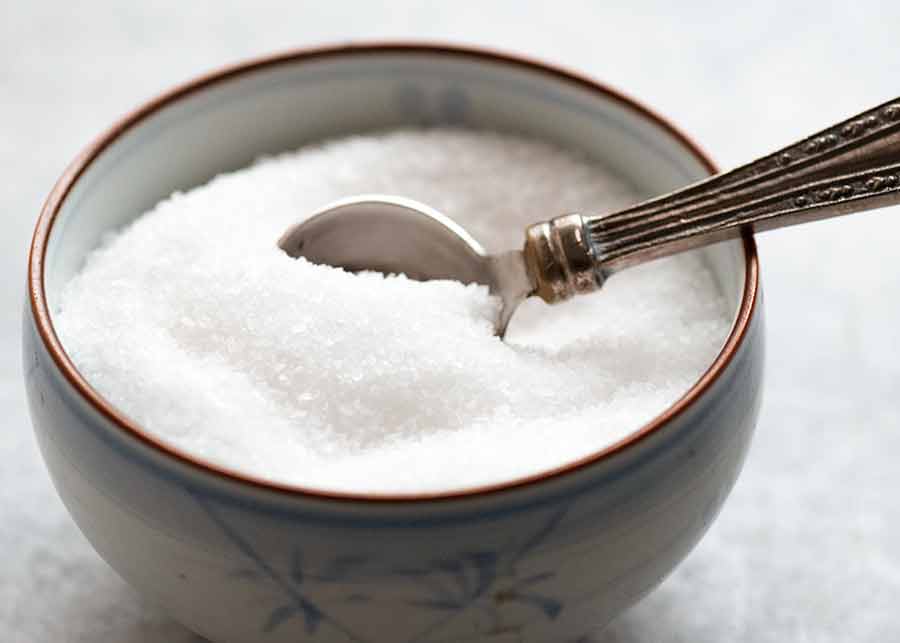
The only thing to notation with homemade stock is that you volition need to add more table salt to whatsoever dish yous're making. This is because most recipes – including mine – presume store-bought beef stock. Store-bought stock is salted, whereas home-made is unsalted. Therefore, you lot need to compensate for this difference.
As a rule of thumb, you will need to add 1/three teaspoon of cooking or kosher table salt for every 1 cup of homemade beef stock in gild to take the same level of table salt as low sodium store bought stock.
And with that, I'm done! The first of a serial of homemade stocks that I plan to share.
Side by side up, fish stock! – Nagi 10
Watch how to brand it
Subscribe to my newsletter and follow along on Facebook, Pinterest and Instagram for all of the latest updates.
Servings 1.five litres / quarts
Tap or hover to calibration
Recipe video above. This is a classical French-style recipe for homemade beefiness stock. It'southward vastly superior to any store-bought stock, and is one of the main things that distinguishes home and restaurant cooking.
It takes time to make, but if you lot truly desire the best, it'due south worth it!
Makes: 1.25 – ane.five L / quarts stock (5 – 6 cups), ready use store-bought forcefulness, UNSALTED. Add i/3 tsp common salt for each 1 loving cup (250ml) homemade beef stock to match store-bought depression sodium beef stock.
Other homemade stocks: chicken stock | vegetable stock
- two.5 kg / 5 lb meaty beefiness basic , dorsum and neck preferably, plus one marrow bone for richness (or knuckles) (Annotation 1)
- one carrot , unpeeled, cutting in half
- 1/two onion (brownish or yellow), peel and cut in half
- 2 tomatoes , cut into quarters (keep seeds in) (Note 2)
- 1/2 tbsp coriander seeds (Note 2)
- 1 tbsp apple cider vinegar (Note 3)
- ane/two tbsp black peppercorns
- 1 celery stem , cutting in half or thirds (leaves on ok)
- 2 bay leaves , fresh (or 1 dried)
- two thyme sprigs (or 1/2 tsp dried leaves)
- 12 parsley sprigs , if you take it (not essential)
- 3 litres/quarts water , cold tap water
Roast basic:
-
Preheat oven to 220°C/430°F (200°C fan).
-
Spread bones out across 2 baking trays. Roast for one hour, turning at thirty minutes, or until very well browned.
-
Drain and discard excess fat, if whatsoever.
-
Place bones into large stock pot (7 litres/vii quarts+ capacity)
Deglaze trays:
-
Identify tray on stove, plough onto medium. Add iii/4 loving cup h2o. When it comes to a simmer, start scraping the tray. The drippings (addicted) on the tray volition loosen and dissolve into the liquid.
-
Once virtually of the drippings are removed from the base, scrape all the liquid into the pot. Repeat with other tray.
Simmer stock:
-
Add remaining ingredients into the pot. Offset with iii litres of h2o, then squish the bones etc downward to fit snugly in the pot. Add more water if needed, to merely cover the basic (ingredients volition collapse a bit as stock cooks). The water quantity depends on shape of bone and pot – my h2o level came to 5.75 litres/quarts mark on pot.
-
Eddy and then simmer: Bring to a boil on medium high, and so turn downwardly to low so it's simmering e'er then gently, with only a small chimera bursting every at present and and then.
-
Remove surface scum: Scoop off whatsoever surface scum using a ladle and discard.
-
Simmer for 8 hours on very low, no lid. Liquid level should reduce to around 4 litres/quarts for all – if not, just reduce after straining (Step 3 under Strain & End).
-
Other methods:
– Stove 3 hours on medium-low (very gentle simmer, with chapeau cracked)
– oven (lid on) for 8 to 10 hours at 120°C/250°F (100°C fan). Water level will only reduce by about 500ml / 0.5 qt. Strain and then rapid boil to reduce to i.5 lt / i.5 qt.
– irksome cooker viii to 10 hours on low. Reduce afterward straining to 1.v lt / 1.5 qt.
Strain & terminate:
-
Strain: Fish out most basic. Strain stock with remaining vegetables through a fine mesh colander / strainer set over a large pot or bowl. Leave strainer for a few minutes to permit information technology drip.
-
Cool to room temperature: Set stock pot or basin in sink filled with cold water. Get out stock to cool for effectually 1h 15 mins, changing water every 20 mins or so as information technology gets warm.
-
Measure stock volume: Pour stock into a vessel to measure volume – information technology should exist between effectually 1.3 – 1.7 litres/quarts. If it's much more than, reduce on the stove, otherwise stock flavor will be as well weak.
-
Refrigerate stock. When fatty has solidified on surface, advisedly scrape off with a large spoon and discard. You should have 1.25 – 1.5 Fifty/Qts remaining.
-
Ready! Beef stock is now prepare to apply! This stock is equivalent in strength to store-bought stock, so it tin can be used one:ane in any recipe calling for beef stock.
-
Table salt adjustment: Bootleg stock is unsalted whereas store-bought stock is salted. Add i/4 tsp salt for every 1 cup bootleg beef stock (250ml) to match the salt level of store-bought low sodium beef stock.
-
To utilise: Cold stock has a jellied consistency (Notation 4). Information technology takes barely a minute to turn liquid on a medium high stove, or microwave. Yous tin can besides but add it in jelly form straight into dishes, just sometimes you may need to liquify it to measure.
one. Bones – Be sure to apply meaty basic considering meat = season. If yous use meatless bones, the stock volition be very bland.
It's too good to include a marrow bone if you tin get information technology (ie. the bones split in half to reveal the fatty marrow inside) as this adds a some valuable richness into the stock. Include this in the 2½ kg / 5 lb.
Australia – The packs sold as "Beef Soup Basic" at grocery stores are fine to utilize, they are pretty compact. But they are more expensive than buying from butchers. Do non employ the really fatty bones sold as "brisket bones". All fat, no meat!
2. Coriander seeds and tomato – These are non commonly seen is very traditional stocks, but are a terrific cheffy tip that elevates the stock. The lycopersicon esculentum adds sweetness and makes the stock colour even richer in flavour, and the coriander seeds adds a touch of actress savouriness. Not the end of the world if yous don't have them.
3. Cider vinegar – Helps extract nutrients out of the bones.
4. Stock consistency when cold is jelly similar due to gelatin. Gelatin gives the stock richness that you don't arrive liquid store-bought stock.
5. Methods of cooking / reducing liquid – yous need to ensure the bones are fully covered in water to ensure the flavor of the beef infuses into the water, so the volume of water required volition differ depending on the shape of basic.
After the required cook time, if the strained stock has not reduced to the target quantity of ane.3 – one.7 litres/quarts, then strain and rapid boil until you achieve the target amount.
- Very low stove for 8 hours with the hat off should get close to the target liquid quantity – 4 litres / 4 qts with the bone in, 1.three – i.7 litres/quarts afterwards straining;
- Medium low stove for three hourswith the hat cracked should likewise get to the target stock quantity;
- Ovenfor viii – 10 hours volition only reduce about 500ml / 0.5 qt so it volition demand to be rapid boiled after straining; and
- Slow cooker volition barely reduce at all so will need to exist reduced.
Do not rapid boil with the bones, it will make the stock cloudy.
half-dozen. Leftover meat on bones – the meat left on the basic don't have much flavour because it'southward in the stock! However, it seems such a waste material non to selection it all off, and so I always exercise and Dozer get it for dinner. 🙂
If you want to utilize it, I'd recommend calculation flavour. You could toss with a BBQ sauce or other sauce, and use as pulled beefiness. Otherwise, you lot could but pan fry in butter and garlic.
7. Storage – seven days in the fridge, or 3 months in the freezer. I similar to portion into usable quantities (ane cup, 2 cups), label and and so freeze in jars.
viii. Nutrition – Calculated for entire batch of stock.
Calories: 121 cal (6%) Carbohydrates: 27 m (ix%) Protein: five k (10%) Fatty: 1 g (ii%) Saturated Fatty: 1 thousand (6%) Sodium: 66 mg (3%) Potassium: 1047 mg (30%) Fiber: nine thousand (38%) Sugar: 12 g (thirteen%) Vitamin A: 13387 IU (268%) Vitamin C: 61 mg (74%) Calcium: 125 mg (13%) Iron: 3 mg (17%)
Life of Dozer
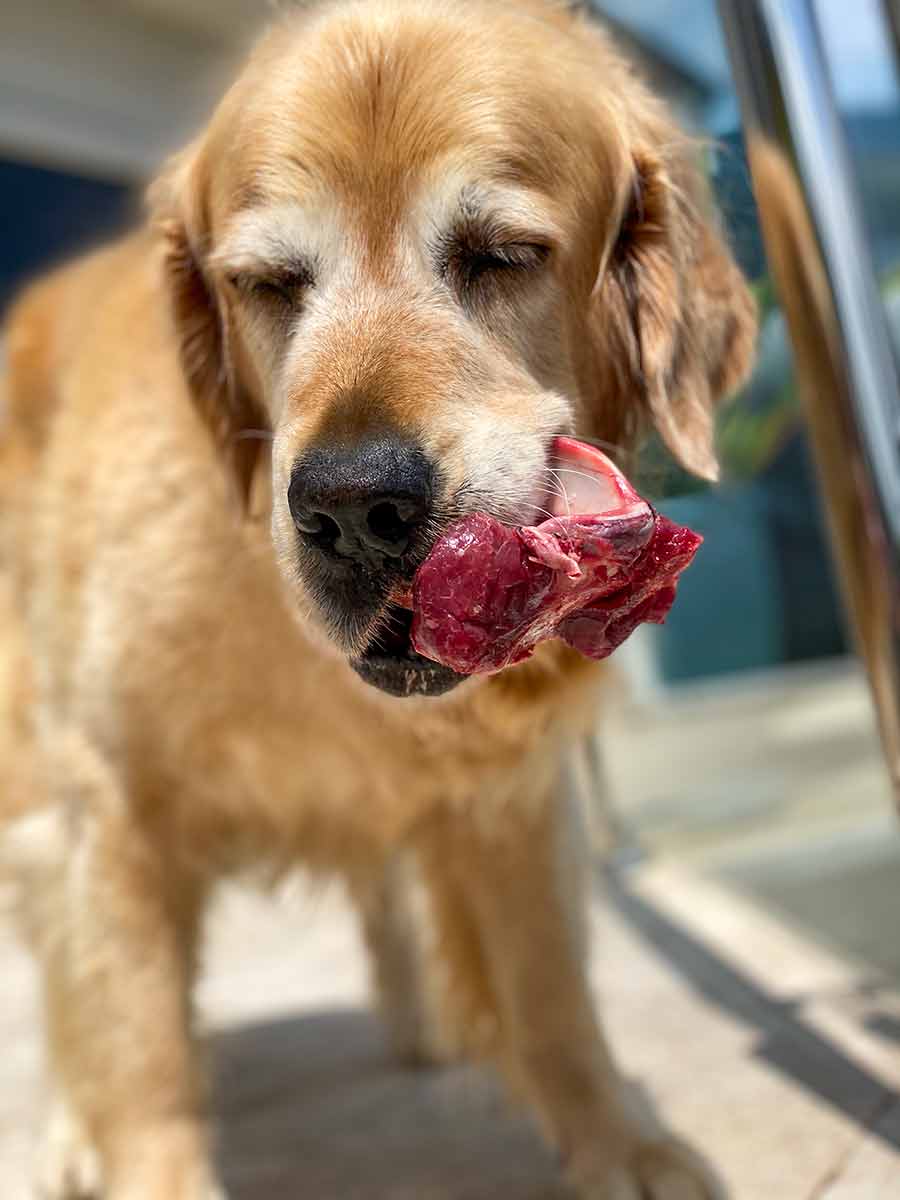
Dozer agrees that meaty bones are best.
Source: https://www.recipetineats.com/homemade-beef-stock/

Post a Comment for "What Are Essential in Making Beef Stock"